


Flooded Corn, Short-Stopping, and What Is Actually Driving Change in Migratory Waterfowl

Every fall, the same argument shows up in hunting camps and across social media, but lately it has reached a new level. Ducks are not coming south like they used to. Some people blame flooded corn. Others blame climate change. The conversation often ends in frustration and finger pointing, and honestly some shockingly bad comments and reply's that make me question credibility, but that is beside the point.

The problem is that both sides are oversimplifying a system that is far more complex than a single cause. When you step back and look at the science, this is not a debate between climate versus agriculture. What we are actually seeing is the interaction of climate, food availability, habitat loss, and human disturbance, all operating together.
ARE DUCKS REALLY STAYING FARTHER NORTH?
Several recent peer reviewed studies using decades of United States Fish and Wildlife Service band recovery data suggest that some species, particularly Mallards and Northern Pintails, are now being harvested farther north in winter than they were historically. One study found that Mallard recovery locations shifted north by about 180 kilometers between 1960 and 2019, with Pintails shifting even farther. Blue winged Teal did not show the same pattern.
That sounds like strong evidence at first glance, but there is an important caveat. Band recoveries do not tell us where ducks are living on the landscape. They tell us where harvested birds were reported. That matters because harvest patterns are shaped by hunter behavior, access to land, season timing, regulations, and reporting habits. All of those things have changed dramatically over the last sixty years.

In simple terms, the data show that more ducks are being harvested farther north later in the season. They do not perfectly isolate whether ducks changed, hunters changed, or both changed together. That does not invalidate the pattern, but it does mean we need to be careful about overstating the conclusion.
Fortunately, newer GPS telemetry studies provide another layer of insight. When researchers track individual ducks in real time, a clear picture emerges. Ducks respond dynamically to local conditions. They adjust movements based on surface water availability, food availability, disturbance, refuge access, and weather. They are not following a rigid calendar.
They are making daily decisions based on risk and reward.
Taken together, the evidence supports a reasonable conclusion. Some species are indeed staying farther north later into the season than they once did. The real question is why.
CLIMATE CHANGE IS CHANGING THE MIGRATORY LANDSCAPE

There is little scientific debate that winters across much of the northern United States and southern Canada are milder than they were decades ago. There are fewer prolonged deep freezes. Snow cover is less persistent. Wetlands and shallow water stay open longer.
Historically, severe cold fronts and frozen conditions forced ducks south. When water froze and food became inaccessible, birds had no choice but to move. That pressure is weaker today in many regions.
Researchers have modeled this directly using weather severity indices that incorporate temperature, snow depth, and freezing days. Those models predict exactly what we are now observing. Milder winters should lead to delayed migration and shorter migration distances, especially for species like Mallards.
This does not mean ducks stop migrating. It means fewer individuals are forced to move as far south as they once were, and fewer are forced to move as early.
Climate sets the stage. It explains why ducks can remain north longer. It does not fully explain where they choose to concentrate once they stay.
FLOODED AGRICULTURE IS AN AMPLIFIER, NOT THE ROOT CAUSE
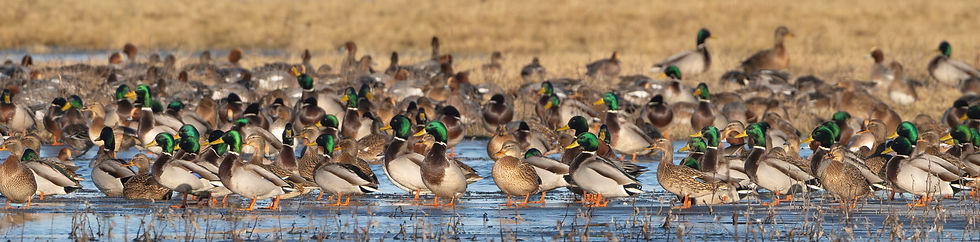
Flooded agricultural fields can provide abundant, predictable, high energy food. That is not speculation. Multiple studies have documented the energetic value and invertebrate availability in managed flooded fields.
From a duck’s perspective, this is basic behavioral ecology. If the weather allows them to stay north and the surrounding landscape is dominated by agriculture, then flooded fields become one of the most profitable options available.
This does not mean flooded corn caused short stopping. It means flooded corn can amplify the effect once climate conditions allow birds to remain in those areas.
Telemetry studies reinforce this point. Ducks do not use agricultural habitats in isolation. They use landscapes. They respond to water availability, energetic opportunity, safety, and disturbance. When those factors align, birds concentrate. When they do not, birds move.
Food matters. Water matters. Refuge matters. Disturbance matters. None of these variables operate alone.
HABITAT LOSS IS THE BACKGROUND DRIVER NOBODY WANTS TO TALK ABOUT
One of the most overlooked parts of this conversation is habitat loss. Across breeding, migration, and wintering regions, wetlands continue to be lost, degraded, or hydrologically altered. Tile drainage, ditching, and development have removed countless small wetlands that once provided food, water, and resting areas across the landscape.

When habitat disappears, birds do not simply vanish. They concentrate into what remains. That includes refuges, managed wetlands, and flooded agriculture.
This is not preference in a vacuum. It is habitat selection under constraint.
Policy decisions also play a role. Recent changes in how wetlands are regulated under federal law mean that many isolated wetlands and ephemeral waters no longer receive consistent protection. These small wetlands are often among the most productive habitats for waterfowl, particularly during migration. Losing them disproportionately affects the very habitats ducks rely on most.
Even our refuge system faces serious challenges. Budget constraints, staffing shortages, and deferred maintenance limit the ability of refuges to manage water, control invasive species, restore wetlands, and maintain habitat infrastructure. Many protected areas are not functioning at their ecological potential, which further limits the amount of high quality habitat available across the flyways.
If traditional wetland systems in southern wintering areas are degraded or reduced, and northern landscapes remain usable longer due to climate, the incentive for ducks to complete long distance migration weakens. That is not ideology. It is basic ecological logic.
DIFFERENT SPECIES RESPOND DIFFERENTLY, AND THAT MATTERS
One of the most important pieces of evidence supporting a multi driver explanation is that not all species are responding the same way. Mallards and Pintails show northward shifts in harvest distribution. Blue winged Teal do not.

That makes sense biologically. Species differ in body size, foraging strategy, reliance on agricultural foods, and sensitivity to weather cues. Blue winged Teal are more strongly governed by internal migratory timing and less dependent on agricultural subsidies. That difference in ecology helps explain why their migration patterns appear more stable.
If climate were the only driver, all species would shift similarly. If flooded corn were the only driver, all agricultural feeding species would shift similarly. The fact that we see species specific responses strongly supports the idea that this system is shaped by interacting ecological forces rather than a single cause.
THE TAKEAWAY
The evidence does not support a simple narrative. Ducks are not staying north because of one factor. They are responding to a changing landscape.

Milder winters reduce the pressure to migrate. Agricultural food subsidies provide profitable opportunities where wetlands once dominated. Habitat loss funnels birds into fewer remaining usable areas. Disturbance and refuge availability shape fine scale movements. Species biology determines how each responds to these pressures.
If we want to improve waterfowl hunting and conserve waterfowl populations, focusing on one villain is not the answer. The real work lies in habitat restoration, wetland protection, functional refuge systems, and an honest understanding of how modern landscapes shape waterfowl behavior.
That is a harder conversation, but it is also the only one that leads to meaningful solutions.


Comments